By Poornima Nagaraja, PMP

Many organizations believe (and rightly so) that utilizing the right set of project management processes would lead to high probability for project success. Hence, if you are working as a management professional and/or practitioner in any organization, you need to understand Requirement Management Processes and its advantages.
One of the fundamental aspects of requirement management is this:
Do what is required and deliver based on available time, money and resources. Over committing has been known to be one of the biggest reasons for project failures.
What is a Requirement?
The Project Management Institute (PMI®) defines requirements as follows:
A condition or capability to be present in a product, service or result to satisfy an agreement or other formally imposed specification.
If a Business Analyst (BA) is available for the project, then all requirement related activities will be part of that role. Project Managers should be collaborating with the BA to manage requirements.
Before further going into details of Requirement Management, let’s understand the difference between Scope and Requirements.
Requirements can be vast, because when you consider all possible items as per customer expectations, the coverage becomes large. However, the scope of the project, program sets the boundary conditions. The scope will have:
- The elaboration of project scope.
- The deliverables to be given to the customer.
- What is included in the project.
- What is excluded in the project within available time, budget and resources, which is tacitly explained by the “inclusion” part.
While managing scope, the Work Breakdown Structure (WBS) plays a key role because when the scope of the project is broken down, you get a WBS. A WBS is applicable irrespective of project life cycle being used. In some life cycles, the term WBS may not be used, but effectively you get it when you break down the scope of the project. For example, in Agile, you take the epics and break it down to user stories.
Now, let’s understand requirements management.
Requirements Management
Requirements Management is a repetitive set of activities that includes determining, documenting, and managing stakeholder needs and expectations during project lifecycle to meet project objectives. Do read this line again. It’s repetitive as it’s both iterative and integrative in nature.
Requirements management also includes tasks, which will establish a requirements baseline and maintain the traceability of requirements, which we will see shortly. In Adaptive/Agile life cycles, requirements are consistently managed with Backlog Refinement. Dedicated time is allocated for such activities.
Requirements management is very crucial to consistently engage with stakeholders and understand their needs and requirements. This ensures the project manager and the team to prioritize requirements appropriately and implement the deliverables in a right way which leads to Customer Satisfaction.
After all, a project is declared successful only when our customers are satisfied. Meeting the requirements of the customer helps achieve customer satisfaction.
Now, requirements are usually managed with the Requirements Management Plan. This plan is the output of a planning process, i.e., Plan Scope Management. This plan tells how project and product requirements will be analyzed, documented and managed. Some organizations may call it the Business Analysis Plan. If a BA is available, it’s his/her responsibility to maintain the Requirements Management Plan.
Contents of Requirements Management Plan
One can think of the following contents for the Requirements Management Plan:
- How requirement activities will be managed.
- How configuration management activities for requirements will be done.
- How requirements will be prioritized.
- What metrics will be used.
- What will be the traceability structure/matrix.
In the previous line, I introduced a term called (requirements) traceability matrix. Let’s understand it.
Requirements Traceability Matrix (RTM)
The Requirements Traceability Matrix is one of the outputs of Collect Requirements process – other being the Requirements Documentation. Requirements documentation lists out all the requirements for your project. In your organization, you may have different names for Requirements Documentation, such as Product Requirements Documentation (PRD), Product Requirements Specification (PRS) or any other name.
Coming to the RTM, PMI defines is as follows:
Requirements Traceability Matrix (RTM) is a grid that links product requirements from their origin to the deliverables that satisfy them.
The RTM creates a clear way to track requirements throughout the project life cycle. It thus ensures the requirements approved in requirements documentation are delivered at the end of the project.
As per PMI, the RTM components can be:
- Business needs and objectives
- Project objectives
- Project scope and WBS deliverables
- Product design
- Product development
- Test strategy and test Scenarios
- High-level requirements to more detailed requirements
A sample of RTM is shown in the below figure. It’s taken from PMI’s Project Management Body of Knowledge (PMBOK®) guide, 6th edition.
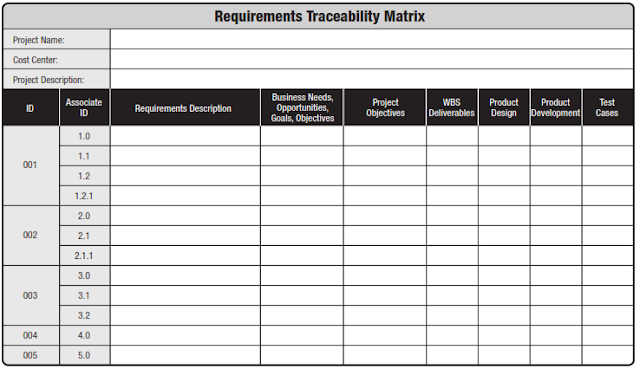
As shown, the RTM is a grid/matrix like structure. There are attributes such as Unique ID, Requirement Description, WBS deliverables, Test cases among others. One can have other attributes such as Owner, Requirement Priority, Versioning etc.
With this, I believe you got an introductory understanding to:
- Requirements Management
- Requirement Management Plan
- Requirements Documentation
- Requirements Traceability Matrix
Brief Profile:
Poornima Nagaraja, PMP. I’ve over fourteen years of experience and currently working as a Quality Assurance (QA) Manager at Infor.
You may also like:
- PMP Protein: Conflict, Conflict Management and Conflict Management Techniques
- PMP Protein: Top PMP Apps to Assist You
- PMP Protein: Understanding Risk Attitude
- PMP Protein: Information Gathering Techniques
- PMP Protein: How To Be A PMI-PMP
- PMP Protein: How To Prepare and Submit PMP Applications
- PMP Protein: Types of Organizational Structures
- PMP Protein: Identifying Stakeholders
- PMP Protein: Earned Value Management – Basics
- PMP Protein: Strategic Planning, Analysis and Alignment
- PMP Protein: Earned Value Management – Advanced
- PMP Protein: Critical Path Method – Basics
- PMP Protein: Seven Basic Tools of Quality
- PMP Protein: Gaps in Project Management in India’s Construction Industry
- PMP Protein: Organizational (Project) Management – A Facelift
- PMP Protein: Facing the Sun
- PMP Protein: Project Management Practitioners’ Conference 2018 - A Feast of Knowledge
- PMP Protein: Requirements Gathering Methods
- PMP Protein: Emotional Quotient – A Risk Factor
- PMP Protein: Ensuring Effective Communication by Team Members and Middle Management
- PMP Protein: Leadership and Team Building
- PMP Protein: Understanding Brainstorming
- PMP Protein: Changing Work Cultures and Organizational Impact


