Showing posts with label Leadership. Show all posts

Thursday, July 23, 2026

Artificial Intelligence, Simulations, Practical Scaled Agile (CIPSA) and the Future


Ich bin dein mensh! It’s not a special prompt used in a Large Language Model (LLM) under the Artificial Intelligence (AI) umbrella, but a German movie in the 2020s meaning I’m Your Man

The movie’s lead character is a highly-educated woman in her forties with no family, or husband, but only “career”. Though initially very hesitant, due to strong persuasion by her supervisor, she had to bring an AI-robot home to assist her in her geological work. Ironically, the robot went on to become her perfect lover! 

The robot looks exactly like a young man (human lookalike), very charming, understands her perfectly and never gets angry – unlike us, the humans. 

Over time, the AI learns from her likes and dislikes, pleasures and pains, highs and lows as well as cooks for her, brings flowers, dances with her, gives caregiving like medicines, and even makes her sleep. One-day the woman falls in love with the AI, and in fact, demands it from the AI-robot. 

When I watched the movie, I kept on thinking:

Can this happen? Is it even possible?

In this article we will explore simulations which are already there and sometimes they go beyond reality as with AI. We also explore AI’s impact on our lives as well as management considering various aspects. I’ll include many examples, including the ones from the Certified In Practical Scaled Agile (CIPSA) framework. See here to know more about CIPSA.

First let’s take an example of a map to understand simulations and AI.

Map to GPS to Simulation 

A paper map simulates space. It presents a static simulation of geography. It's a symbolic abstraction of terrain, borders and mountains. A map informs about the terrain, but is not the terrain itself. 

A GPS goes further. It provides dynamic – not static – simulation by guiding us in real time. It tells where to turn left or right, when to stop, or have an alternate route based on traffic condition. A GPS shapes how we perceive and travel in space. 

Now, AI systems such as driverless cars simulate the cognitive process behind space exploration. It not only tells us how to get somewhere, but where to go, or why it matters. It can factor in our curiosity, context, and our personalized goals.

So, in short: 

A map simulates geography. A GPS simulates navigation. But AI simulates decision-making. 

It’s shown in the below figure.  

In a driver-less car, the decision-making is based on the rider’s habits and likings. In other words, there is a human in the loop (HITL) and it may change the route of the car based on the rider in the car. The simulation in AI shifts from external space to internal cognition. 

Now, as a management professional and leader, you would be wondering:

  • How does this fit into traditional or agile management?
  • Can it be applied in various fields, e.g., Scaled Agile?
  • How can it help us?

Let's take an example of tasks and Scrum board using the CIPSA certification

Task to CIPSA Board to Simulation

A task simulates work. Whether it’s a CIPSA Sprint Backlog or individual Team Sprint Backlogs, a task or list of tasks will always be there. It's also applicable in traditional project management.

Now, consider yourself as the Principal Scrum Master (PSM), one of the key roles in CIPSA. You would be adding tasks into a schedule using MS Project (Agile) or other software tools. But the task (or activity) is not the work itself. When resources execute that task or a list of tasks, then only the actual work gets done. 

A physical or digital board, on the other hand, simulates coordination and/or collaboration. 

For example, when the CIPSA team puts tasks as cards on a CIPSA Scrum or Kanban Board (see here), it simulates coordination and collaboration among the individual Scrum teams. This integrated board has various workflow states across individual Scrum or Kanban teams. 

An AI system goes much further in simulation

It can simulate a part of your cognitive process and can be a companion. It not only can assist the PSM, the Chief Product Owner (CPO), or the CIPSA team in breaking a story into tasks, but also in anticipating bottlenecks, quickly informing resource overallocations, and how to resolve them. 

So, in short: 

A task simulates work. A CIPSA board simulates collaboration. An AI system simulates cognition. 

You may call it a PSM-Copilot as it simulates certain cognitive aspects of a PSM. It’s shown in the below figure.

From Manualization to Autonomous

The work that we do in our personal or professional lives can be simple, complicated, or complex. Almost all of us take the help of machines or tools in our daily lives. The usage of machine/tools can be low, medium or high. Overall, it can take four forms:

  • Manualization: Low on complexity, and low machine use. For example, caregiving.
  • Augmentation: High on complexity and still low on machine use. For example, brainstorming with an AI tool.  
  • Automation: Low on complexity, but high on machine use. For example, report generation which is completely automated. 
  • Autonomous: High on complexity and high on machine use. For example, driverless cars. In fully autonomous cars, humans are not at all needed. 

This is shown in the below figure. 


As shown in the above figure, we have four aspects, but with nuances. 

Manualization usually is low in complexity and machine use. However, in certain areas of manualization, we require a high degree of emotional understanding. For example, the manual work needed for cutting a tree and caregiving are not the same. Caregiving is low-tech, but high-touch.

When the complexity goes up, but we still need human touch to get the work done, we have augmentation. Here the machines enhance our ability to do the work. We have many such examples:

  • Brainstorming,
  • Planning (some aspects),
  • Estimation (story points as can be used in CIPSA Scaled Agile),
  • Resource levelling – also used in CIPSA Scaled Agile.

Automation can occur when the work done is typically of low complexity but with rules applied. It has high machine usage. For our case, we can apply automation in:

  • Reporting,
  • Processes and adherence to processes,
  • Triggering alerts and suggested actions to stakeholders,
  • Real-time dashboards, among others.

The final one is that of autonomous, where the decision is completely machine driven and the work is of high complexity. Taking some examples, we can have:

  • Driverless (autonomous) cars,
  • Pilotless planes,
  • Drones for monitoring,
  • Autonomous drug discovery etc.
As autonomous AI systems start to get into our lives, a question arises–what it means to be a human.

Meaning of Being a Human

We humans are no way perfect – in fact, far from it. We get disappointed, get angry, and have frustrations. At the same time, we fall in love, have kindness, and show genuine empathy. 

We humans grieve and cry when someone near and dear to us passes away. Because we truly feel so. And that’s what makes us human – not just natural intelligence, which animals also have to a certain extent. For example, elephants and dolphins display a few aspects of near-human-level intelligence!   

Remember our opening story? 

The AI-robot does all the above, or at least pretends. It pretends to empathize, pretends to care, and does the acting of forgiving or being in love. The robot can mimic our human emotions, too.  

The AI-robot is not only learning from us, with us, and by us, i.e., the humans, but trying to be us. It is the perfect lover as the opening story goes, or the perfect human! 

But then it’s not human. It doesn’t possess many human-like in-born qualities or human-like emotions. 

AI doesn’t feel on its own. It’s programmed to feel. AI doesn’t show real emotions. It’s programmed to show. For us humans though, it comes naturally from birth. From birth, we humans are conscious – not programmed. 

However, in some countries AI robots using human clothes and shorts are seen playing with children, and children are seen as enjoying such companions. It may bring in a completely new generation in the future where robots may be perceived as humans or at least no less than humans. This indeed leads to completely simulated lives and living. 

A Conclusion?

For this article, and perhaps for the first time, I’ve no conclusion as I don’t know where or how it ends! 

Current Gen-AI tools are useful in areas as I explained with our CIPSA example, e.g., building tasks, estimating story points, or resolving over-allocations. 

But the direction for AI seems to be in another way as informed with the previous example of AI robots pushed onto children. The kids are being mentally programmed to think AI as humans and live in a simulation.

In such cases, the boundary between reality and simulation is no longer blurred or invisible. It has ceased to exist.  

So, where does it lead us?

  • Will AI replace us humans?
  • Will AI do all the jobs done by portfolio, program, or project managers?
  • How many of us sit with Agentic AIs in CIPSA Daily Scrums which mimics us and then replaces us?
  • How will a PSM or CPO coordinate among the Agentic AIs? How many humans in the loop (HITL) will be there? 
  • When is that expected to happen?

As said earlier, these are uncertain, but the current path taken by some organizations is leading to that direction. 

For now, I’m certain about a few things. For example, AI can’t procreate on its own, though there are quite a few attempts to manipulate it.  

So, is our future about complete AI with a few humans? Also, what about the previous questions to managers and leaders? 

Your thoughts and comments are welcome.

--

This article is dedicated to the memory of my father, the late Harendra Nath Dash, who passed away seven years ago on June 11, 2019. The world moves forward by people who give, not by people who take. He gave a lot and changed many lives, but took very little back. 

This article is free to read, learn, and share. It’s a tribute to him and his teachings.


References

[1] Certified In Practical Scaled Agile (CIPSA), by ManagementYogi.com

[2] Agile and Artificial Intelligence (AI) – Three Cs of a User Story and Three Cs of a Prompt, by Satya Narayan Dash, CIPSA, CHAMP.

[3] The Future of Project Management: PMBOK 8th Edition with Artificial Intelligence, by Satya Narayan Dash, CIPSA, CHAMP.


Friday, March 17, 2023

A Masterclass in Leadership: Leadership, Leadership Levels, Leadership Styles and Qualities for Project Managers


We need a leader. Courageous, self-sacrificing people, setting examples for all of us. Everybody loves a leader, people line up for ’em, cheer for ’em, scream their names, and years later tell how they stood in the rain for hours just to get a glimpse of the one who told them to hold on a second longer.

– From the movie, Spiderman 2


The above, slightly paraphrased quote comes from the Spiderman 2 character, Aunt May, an old, frail-looking, but very warm, kind, and gutsy woman. She taught the young, down, and dejected Peter (Spiderman) the basics of leadership. One important part in the quote is courage.

Consider a big-budget movie being produced with hundreds of staff working on it. There are multiple managers also putting forth their best efforts, but many think the movie will not succeed in the market.

A leader is one who stands in front of everyone and calls out, “Wrong movie!” It takes courage to say that. Imagine the opposition and backlash. Some managers may negate it, or even scoff at it and indicate they are making progress. But what is the meaning of “progress” if you are building the wrong product?!

Leaders will have a vision and long-term goals, with which they are able to foresee how things will play out. Managers execute that vision. Leaders don’t always know the terrain, hence they navigate with something like a compass. Managers have to know the terrain, and hence, need to use maps. Leaders constantly monitor the environment and change directions. They are change agents. Managers use roadmaps and follow directions. They are change adaptors.

So, there’s a difference between managers and leaders?

I see it this way. Every leader has management capabilities. But every manager doesn’t have leadership capability. A truly good manager is also a very good leader. Management is about meeting objectives, whereas leadership is about purpose, passion, and enabling people to be successful.

With this background in mind, let’s turn to project management and start with the definition of a project manager (PM). In this article, I’d like to explore how leadership can transform management roles.


Project Manager as the Leader

I define a project manager as follows:
A project manager is an individual on the project formally assigned to lead the project team in order to meet the project objectives.

The Project Management Institute (PMI) in its definition also emphasizes leadership aspects, and I quote: The project manager is the person assigned by the performing organization to lead the project team that is responsible for achieving the project objectives.

Did you notice the underlined emphasis? It’s not about managing the project team, but about leading the team.

We can see that the leadership aspect is very important. I define leadership for project managers as follows:

Leadership is the capability to influence people through inspiration toward the desired outcomes of the project.

Why is this needed? Projects are unique endeavors and unlike operations, where roles and responsibilities are often established. Because of this unique, cross-functional, and sometimes even cross-organizational nature, projects demand a unique need: effective leadership.

This article focuses on PMs, but the content can very well be applied to a variety of management roles and spheres of life. In fact, many executives show a complete lack of leadership, though they may be very efficient managers.

Notice the term “efficient” being used for managers. Leadership is not about efficiency, but about effectiveness. Management is about hands (efficiency), whereas leadership is about heart (effectiveness). To understand this aspect more, let’s see the differences between management and leadership.


Leadership Vs. Management *** UPDATED ***
As we have seen, the project manager is the leader of the team. This is irrespective of the organizational structure. However, leadership and management are not the same.

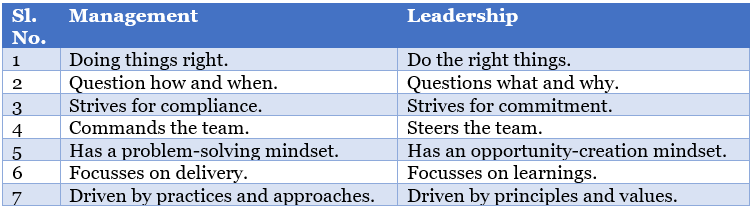
Management involves directing the team to move from one point to another with a known set of expected behaviors. Leadership is not about directing, but about guidance with discussion and dialogue (not debate) from one state to another.


The comparison table below notes a few more differences between management and leadership.


Now, you may be wondering how one can have such diverse thinking and such a leadership mindset at the same time? The key is finding a balance based on the situation and the context.

Authority Vs. Leadership *** UPDATED ***
In many cultures, leadership directly equals authority. Command and control is the only way to get things done.

Putting that into an organizational perspective, line or functional managers mostly follow one leadership style: command and control (autocratic), because they control salaries and raises.

However, as a project manager, most of the time, you won’t have this form of formal or positional power with its uses and/or parenthetical abuses. The best thing to do in such a case is to recognize that leadership is not authority.

Authority is given to a person by formal means, document, or title, but the following is also true:

  • Authority may not motivate. If that were the case, every country would produce a hundred Olympic gold medalists. Does that happen?
  • Authority doesn’t mean expertise. A person with high expertise, knowledge, and skills is, in fact, more followed than one with authority.
  • Authority doesn’t mean respect. Intrinsic respect from one’s heart is different from enforced respect.
  • Authority doesn’t imply trust. People may comply with authority, but don’t always commit to it.

So, what should one do? I’ll outline two things I have learned:

  • Recognize that the best form of power is not formal. It is expert power, relational power, and persuasive power, among others. Such is exercised mostly through inspiration, because your actions - not words - inspire others to dream, act, and be more.
  • Understand that leadership styles can vary. It’s best to apply leadership styles based on context and situation. We will review several leadership styles in a moment.


Leadership Growth Levels
*** UPDATED ***
The growth levels of leadership are depicted in the below figure. This is based on my research, experience, and over a decade of interactions with thousands of managers. You may be seeing it for the first time. It is taken from my new course: A Masterclass in Leadership.


The lower levels of leadership are Positional (Level-1/L1) and Relational (L2). At L3, Inspiration, you have started to truly move up. When you deliver results (L4), you are established as a leader. The higher levels of leadership are Mission (Purpose), and Passion. The highest level is Culmination (L7), which very few reach.

Siddhārtha Gautama, known worldwide as the Buddha, the self-awakened and enlightened one, was one such leader in spiritual dimension. The teachings of leaders at the highest-level echoes in eternity.

Such a leader doesn’t want to be photographed everywhere, but people want to be photographed with the leader. The leader doesn’t put his picture everywhere, but people carry his picture and frame it inside their homes. The leader doesn’t pay the media to promote him or her 24*7 as we see today, but people come voluntarily to listen as they can smell: a real change is in the air.

I’d also like to say the best leaders are finally invisible. This type of leader is not seen but felt because he has enabled other leaders!

Leadership Styles
Various leadership styles are noted and described in the below table:


So, which leadership style is the best?

My answer to that is: not one in particular, as leadership style depends on a variety of factors. Sometimes, you may have to combine multiple leadership styles.

A Leadership Style Exercise
Let’s do an exercise to understand leadership styles better. In the below table, we have a number of situations. Think about which leadership style fits the particular situation.
 
The answers are explained in the below video [Duration: 04m:52s], which I’ve prepared in support of this article. The content of it is taken from my leadership course. Additional explanations and new leadership styles are also provided. For a better audio-visual experience, you may want to go full HD and plug-in your earphones.


Conclusion *** UPDATED ***

Before I sign off, I want to mention some frequent questions that come up regarding leadership.

Why does leadership fail?

One key reason is that leaders don’t follow their own preaching! The leader must role model the behavior he or she is expecting from others. It’s the ‘setting examples for all’ part in the opening quote.

How does one become a leader?

Also from Aunt May:

“I believe there’s a hero (leader) in all of us, that keeps us honest, gives us strength, makes us noble, and finally allows us to die with pride. Even though sometimes we have to be steady and give up the thing we want the most.”

An oft-ignored leadership quality is sacrifice. As a leader, you have to sacrifice a lot. You have to give a lot without expecting anything in return. Managers don’t sacrifice, but for a leader it’s a must.

Many don’t understand the importance of sacrifice. This is important because to get you must give first. It’s paradoxical, but true. But how many of the currently “supposed leaders” do that? You know the answer! You see, true leadership is exceptionally hard.

Peter gets Aunt May’s message. He is teary-eyed but more determined; emotionally choked, yet raring to go. He also understands one painful aspect of leadership 
– making many sacrifices, but still being hated. He also understands there are many who love him dearly. So, putting his disappointments behind him, he gives it another try the very next day. 

As Aunt May rightly tells, the hero is inside you. A leader is also inside you. Search for that leader, and when you discover it, nurture and expand it with the levels and styles we have reviewed. The path may be long and arduous. Sometimes you might stumble or even fall. But, if you are true to your heart, you are unlikely to be disappointed with the result.

I wish you all the very best in your journey and welcome your thoughts and comments. 

--

This article was first published by MPUG.com on 13th September, 2022. This is an updated version.


References
[1] NEW Course: A Masterclass in Leadership, by Satya Narayan Dash, CIPSA, CHAMP

[2] A Guide to the Project Management Body of Knowledge, by Project Management Institute


Sunday, September 25, 2022

A Masterclass in Leadership: Understanding Leadership Growth Levels and Its Application


Recently, I wrote an article on leadership and what leaders do. It informs on the following:

  • Who is a Leader?
  • Leadership Vs. Management
  • Authority Vs. Leadership
  • Leadership Growth Levels
  • Leadership Styles
  • Exercises (video)

You can read the complete article here:

Leadership, Leadership Growth Levels and Leadership Styles for Project Managers

I strongly suggest that you read the above article before proceeding with this specific one on Leadership Growth Levels and its application. In the above linked article, the leadership growth level has been depicted with the following figure.  


I also noted:

“The lower levels of leadership are Positional (Level-1/L1) and Relational (L2). At L3, Inspiration, you have started to truly move up. When you deliver results (L4), you are established as a leader. The higher levels of leadership are Mission (Purpose), and Passion. The highest level is Culmination (L7), which very few reach.”

With this foundation, let’s understand the Leadership Growth Levels in more detail. Towards the end of this article, you will learn how the levels are applied.

Level1 (L1): Position

We all begin somewhere in a team or organization. Only exception is your family, where the team has been built over years, early in your life.  

You start at a positional level (L1), because of your designation, title, hierarchy or position. For example, when you are hired as a manager, you are actually at L1. You have been hired because of potential or past performance. This is the foundation on which you have to build further.

Level–2 (L2): Relation

It is the next level up when compared to the positional level. You have moved up because you are building relationships with your team members, colleagues within the organization or across organizations. Even within a family, your position as an eldest sister (say likely to be respected) or youngest brother (say likely to be adored) won’t be stable if you don’t work on your relations continuously.  

An old-age saying in leadership goes as follows:

People follow leaders whom they trust. 

Trust is the foundation of leadershipHow do you develop trust? It starts first by building relations and gets concretized with your character as you move up.  

At this level, you have taken your first and real step towards leadership. At this level, you are not living off your position, title or designation, but relying on influence built through relations to lead. 

Level–3 (L3): Inspiration

In my classes and interactions, I find managers without energy, desire or passion to excel. Some of them have no motivation at all. They are tired by their daily grind of work, family issues or other challenges. Work has no genuine meaning except to earn a salary and pay the bills.

Why does this happen? 

A lack of inspiration. This is where leadership comes in. Because inspiration is really hard. 

When you see zombie-like employees, workers or people lacking any enthusiasm or motivation, it’s first and foremost a leadership failure. To inspire others, the first person who must be inspired is you. 

Level–4 (L4): Fructification

In certain leadership literature, this may be called “production” or “reproduction”. I’ve thought hard about the usage of such words. I believe such words have an emotion-less, non-human and a machine-like connotation. 

People are not machines for production. They all have wants, hopes, desires and aspirations. Hence, fructification is more appropriate. It also signifies one more aspect – the pain of building something and pleasure of seeing your effort blooming like a flower or fructifying on a tree that you have planted. 

With fructification, your work is finally producing results. Results speak the loudest, above anything else. 

Some think that fructification means a one-time effort: you have got the fruit, used it and it’s over. Wrong! Imagine a mango or orange grove or a tea garden. Do you have just one fruit, one tree, or many?

You get many fruits when you plant many trees. The trees that you are planting are the leaders of the future and they will bear more fruits.

Level–5 (L5): Mission

As noted earlier, this is a higher level of leadership. At this level, you are driven by a purpose. You are no longer satisfied with the results being delivered, but want to move with purpose

Purpose is the why aspect of leadership. It articulates your reason for existence as a leader and tells you where to go. In fact, purpose gives meaning to an organization's (and leader’s) existence. 

Mission is accompanied with the values. Along with vision, mission tells exactly where you are going, and the values describe the behaviors needed that will get you there. Vision created at the level of Passion (L6) meets your Mission at L5. 

Level–6 (L6): Passion

This is another higher level of leadership and as the first figure depicts, it’s above the level of purpose. Why?

Because at this level, you are deeply driven by your principles, values and beliefs. In fact, you have full conviction of their worth, worthiness and impact on your team or organization. Passion is the fuel that propels your journey.

A key aspect at this level is the creation of vision. Vision is the future state of an organization or product/service being offered. Vision provides long term direction. As you have consistently delivered at L4 and moving with a purpose at L5, the vision becomes clearer for you and hence, vision is embryonated here. 

Many think a vision is like a light-bulb suddenly going in the leader’s head and then the leader immediately starts working on it. While rarely and occasionally it might be true, in fact, many times a vision emerges

Level–7 (L7): Culmination

As noted in the beginning of this article, this is the highest level of leadership, which very few reach. At this stage, you have become a force of nature. People in the organization or community are drawn to the leader because the leadership is entirely principle driven, the leader himself or herself radiates values and lives by it. The leader rose to this level because the leader has consistently performed at L6, L5 and L4 for decades. Hence, it usually does not happen early or even at mid-level, but towards the later phases of life and career.

Such leaders not only transform organizations, but also create exceptional leaders within the organization or community for generations to come. That’s why with a L7 leader in an organization or community, the organization stays relevant and powerful for a very long time, sometimes more than a century. In some cases, such a leader’s philosophy and teachings resonate for millennia. 

Application of Leadership with Leadership Growth Levels

Now that we have learned the leadership growth levels, next obvious question is:

How leadership is applied considering the levels?

When you apply leadership, it’s in reverse. It’s paradoxical, but true and real. Effectively if you look at the application of true leadership, our first figure gets inverted, which is shown below.

The above figure illustrates the following:

  • Your passion creates a vision. 
  • Vision enables your purpose or mission.
  • With vision and mission, you are producing results, i.e., fructification.
  • Consistent fructification inspires people. 
  • Inspiration builds more relations and draws more people into your orbit. 
  • Finally, decisions are taken who are the potential leaders who can hold new positions.

So, while you are growing as a leader from position to relation to passion, when you are a true leader, you have the vision implemented in a reverse way. Though it may not be easy to absorb in you first reading, if you go through a few times, you will understand how and why it works that way. 


References:
[1] NEW Course: A Masterclass in Leadership, by Satya Narayan Dash
, CIPSA, CHAMP

[2] Article: Leadership, Leadership Levels, and Leadership Styles for Project Managers, published by Microsoft Project User Group (MPUG)


Thursday, January 06, 2022

A Deeper Look: Top Changes in the New 2020 Scrum Guide for Agile Practitioners


A new version of Scrum guide was released in November, 2020. There are quite a few changes in the guide, as well as new additions. While the outline and structure of the guide have remained almost the same, as you go through the guide, you will immediately notice three high-level changes:

  • The new guide is a much lighter and smaller version.
  • It’s less prescriptive and seems to be intended for a wider audience group, particularly non-software users.
  • It contains commitments for each of the Scrum artifacts.

In this article, I’ll outline the top changes and the deeper meaning associated with each change. My perspective is based on my analysis, my own interpretations, and the interactions I’ve had with Agile practitioners who follow my publications, books, and/or courses. 

Product Goal

The Product Goal has been defined clearly. It’s not an introduction because it existed earlier, but in the previous version, it was mentioned along with the vision.  

As per the guide, the Product Goal is the future state of the product. This definition of the ‘goal’ can create confusion for many who understand project-program-portfolio management and how goals aligns with the vision, mission, strategy, and objectives of an organization.

Ideally, the vision is the future of a product or program/portfolio or an organization. A vision is always associated with goals, without which a vision has no value or meaning.

However, as you look closely at the new guide, a big picture emerges:

  • The Product Goal is the long-term objective of the team.
  • A team works on and fulfills a single objective at a time.
  • Before tackling another objective, the team has to fulfill (or abandon) the objective they are currently working on.

In other words, the goal is written with one or more objectives for the team. As the product roadmap is prepared, it gives further directional clarity to the product goal. The product goal should be linked to the strategic goals of the organization. One could summarize this by saying:

  • The Product Goal is more strategic in nature, whereas,
  • Sprint(s), mentioned as a project in the guide, will be tactical in nature.
  • With each Sprint (iteration), the product moves closer to the product goal.

The Product Owner (PO) is the person who is responsible in building, and clearly communicating product goal to the team. The items in the product backlog (PBIs) should map to the Product Goal. Product Goal also reflects one of the values of Scrum: “Focus.” The team, as earlier noted, should focus on one objective at a time.

Now, you may be wondering what happens when multiple teams are working on the product backlog?

Regardless of the number of teams, there will be a single product backlog, a single PO, and a single product goal. This is depicted in the figure below.


Commitment based Artifacts

Now, every artifact in Scrum comes with a commitment.

The formal artifacts in Scrum are three:

  • Product Backlog
  • Sprint Backlog
  • Increment

Now, all these artifacts come with commitments to ensure transparency and progress.

  • For Product Backlog, the commitment is the Product Goal.
  • For Sprint Backlog, the commitment is the Sprint Goal.
  • For Increment, the commitment is the Definition of Done (DoD).

While Product Goal is newly introduced, Sprint Goal and DoD (earlier called “done”) existed earlier. In the new guide, all of these have found homes. For example, the home of Product Goal is the Product Backlog. 

At this point, it may be useful to note that “Commitment’ is also one of the values of Scrum, others being Focus, Openness, Respect, and Courage. Hence, one can say that commitment-based artifacts are reflections of one of the Scrum’s values. Commitments also increase “Focus,” another Scrum value.

I’ve mentioned the values here, because I believe they are very important, but you shouldn’t confuse values such as openness, courage, honesty, etc. with the value that you get while delivering an increment, although the latter is also important.

As the saying goes, “Culture eats strategy for breakfast.”

In my view, it’s actually the values and value-system which eat strategy for breakfast. Strategy execution is the downstream of culture. Culture is the downstream of human, team, or organizational values. And values are the downstream of the philosophy on which civilizations (or a team/organization) is based.

At times, values are thrown around like punchlines, brandished as political weapons, or misused for self-serving interests. It’s true adherence to values that really matters because without values, nothing really works. This is true for a person, team, organization, or even a civilization.

As we proceed through the other changes, I’ll continue to reflect on the Scrum values. 

Multiple Increments

Earlier it was mentioned that an Increment will happen at the end of Sprint. Now, within a Sprint, multiple Increments can happen.

An Increment happens when a backlogged item meets the DoD. Hence, an Increment can be created at any point of time during a Sprint. This is depicted in the below figure. 

As shown, at the end of the Sprint, we have Increments. Increments can also happen at any time during the Sprint. The new guide clearly informs that Sprint Reviews should not be considered “gates” for releasing value.

As there can be multiple Increments, the sum of all these Increments are presented to the (key) stakeholder at the Sprint Review. 

Introduction of Cadence

For the first time, we are introduced of a concept called “Cadence.”

This is an important introduction, which is missed by many Agile practitioners. Cadence is used in other Agile frameworks such as Kanban, and is basically a rhythm that gets developed as one continuously follows a set of events over a period of time.

In Scrum, the cadence is provided in the form of five events:

  • Sprint – the container event
  • Sprint Planning, Daily Scrum, Sprint Retrospective, and Sprint Review – the contained events within a Sprint

I’ll suggest that you read this change along with the previous change of “Multiple Increments.” As you go through these updates together, you can see two things emerge:

  • Development is happening in cadence, whereas,
  • An Increment can be there at any time during the Sprint.

You can say development (or build) of the product and incremental delivery have been decoupled. In fact, they can be thought to be of two streams as shown below.

As shown, the stream for cadence is decoupled from the stream for increment. The diamond shapes in the cadence stream denote the Sprint Reviews. While there is an increment at the end of the review, on-demand increments can happen at any time, as we see in the increment stream.

Cadence helps with inspection, which is one of the pillars of empiricism. This, in turn, drives another value of Scrum: “Openness.” 

Lean Thinking

Earlier the guide referred to empiricism. Lean thinking has appeared for the first time.

Empiricism is a practice which is based on knowledge coming from experience and what you know or have observed. The three pillars are: Transparency, Inspection, and Adaptation.

To include and encourage lean thinking, the wording in the guide has changed in quite a few places. For example, the guide notes: “Transparency enables inspection. Inspection without transparency is misleading and wasteful.” Again, remember that “Transparency” (or Openness) is one of the values in Scrum.

A key principle of lean thinking is to avoid “Muda,” a Japanese term meaning “waste.” When work is not done after being taken into a Sprint, the result is Muda. With DoD, Muda is avoided. Do remember DoD is the commitment for an increment. With DoD:

Introduction of “Why” in Sprint Planning

Other than “what” to do in the Sprint and “how” to do it, the “why” aspect has been introduced.

Earlier, before the start of Sprint Planning event, two questions were emphasized:

  • Topic – 1: What should be done in this Sprint?
  • Topic – 2: How do we do it within the Sprint?

In the new guide, emphasis has been given to Sprint Goal. Hence, we now have three aspects:

  • Topic – 1: Why is this Sprint valuable?
  • Topic – 2: What should be done in this Sprint?
  • Topic – 3: How do we do it within the Sprint?

This is shown in the below figure. 

Sprint Goal has to be collaboratively defined by the entire team. The introduction of Sprint Goal in the Sprint Planning event, reemphasizes a value of Scrum: “Focus.”

Single Scrum Team

Earlier, there was a Development Team within the Scrum Team. There is no ‘team within team’ now.

A Scrum Team is one, and it consists of the Product Owner, Scrum Master, and Developers. This is a step away from the “us-vs-them” mentality created with the term “Development Team” earlier. It also avoids a “throw-over-the-wall” mentality (i.e. my or my group’s work is done and now is the time to throw it over the wall, so that the other group takes care of it!)

Now, the team is considered to be a cohesive unit of people focused on the Product Goal. The PO, SM, and Developers are all intrinsic parts of the Scrum Team. The new version of the guide also notes that the team is the fundamental unit of Scrum.

The single Scrum Team concept enables two values of Scrum: “Respect” and “Openness.” With a single team concept, there is less likelihood of “us-vs-them” mentality.

Also, a single team concept with no hierarchies creates a culture where everyone knows that the team succeeds or fails together, hence candor goes-up. It’s likely to stop compartmentalization of members, prohibit group or community biases, reduce politics, and cripple finger-pointing, and eliminate blame-games and back-biting. If one team member is failing, it means the whole team is likely to fail with their ability to meet the goals of Sprints, the goal of the Product, or the honoring the DoD. The team moves towards, or strives to be, an indivisible whole.

Self-Managing Team

Instead of “Self-organizing,” the team is now “Self-managing.”

Agile teams are cross-functional meaning that they have all the needed skills to do the work and create value in each Sprint. Along with that, whereas the team was described to be self-organizing in the earlier edition, the terminology has now been changed to self-managing. There is a subtle difference between these two terms. Self-managed teams go one step ahead of self-organized teams.

A self-organizing team chooses who will work and how to do the work. A self-managing team, on the other hand, chooses who, how, and what to work upon. In my view, the team can consider the new aspect of “what,” because the PO is now explicitly part of the team.

It’s not that a team will be self-organizing from Day 1 or even within a few weeks of interactions. The team has to go through the stages of team formation, such as forming, storming, norming, and performing.

Also, with the introduction of “what,” the team decides which items are to be taken-up for the next Sprint. This, in turn, reflects another aspect of Lean Thinking: “Muri,” another Japanese term meaning “overburden.” As the team decides what items are to be taken-up, Muri is less likely to arise. When what items are determined at the beginning of the Sprint, it reflects another aspect of lean thinking: Just-in-time (JIT).

Not a Servant Leader, but a Leader who Serves

The Scrum Master being referred to as the Servant-Leader of the team has been removed.

The guide currently notes, “The Scrum Masters (SM) are true leaders who serve the Scrum Team and the larger organization.”

This enables the SM to play a larger role in the organization. The SM is not only now accountable for establishment of Scrum, the SM also leads, trains, and coaches the organization on Scrum adoption. He or she also advises the organization on Scrum implementation.

In my view, this is a positive change because I’ve noticed that the words, “Servant Leader,” have been weaponized by some teams. The SM is not a clerk or secretary to take notes during Sprint events and send meeting emails or reminders. The role of a SM is much bigger with a focus, not only on the team, but also playing a broader role in the organization. This larger aspect is emphasized by putting leadership first.

As you go through the new guide, you may also notice changes such as:

  • The three questions of Daily Scrum are no longer mentioned.
  • One process improvement item from Sprint Retrospective, which must be taken into the next Sprint’s backlog is no longer there.
  • The term “useable” has been used in place of the term “releasable,” among many others.

In this article, I’ve elaborated on some of the top changes. I hope you are not only aware of these, but understand the deeper, philosophical reasonings behind these changes in the Scrum framework.

--

This article was first published by MPUG.com on 29th December, 2020.  


References

[1] Online Course: PMI-ACP Live Lessons, Guaranteed Pass or Your Money Back, by Satya Narayan Dash, CIPSA, CHAMP

[2] Book: I Want To Be An ACP: The Plain and Simple Way, 2nd Edition, by Satya Narayan Dash, CIPSA, CHAMP

[3] The 2020 Scrum Guide, by Ken Schwaber and Jeff Sutherland


Thursday, January 23, 2020

PMP Protein: Changing Work Cultures and Organizational Impact

By K Suresh, PMP


In this article, we will see how changing work culture can hurt an organization’s productivity, profits and sustainable growth. 

With a new set of workers, an organization also brings new cultural aspects, which will impact the organizational culture. 

While I have had experiences in power and construction industry, these challenges are also being felt in other industries as well. 


Changing Work Culture
Let me outline some areas and inform how the organizational culture is impacted by a variety of causes related to new generation of workers. 

Cause #1: Lack of awareness of work place ethics among the Gen – Y and the Millennials (the fourth-generation employees) 
Since childhood, the younger generations – predominantly Gen-Y and the millennials - were brought up with:
  • High comfort levels,
  • Marks oriented education without proper maturity on human values,
  • Lack of beliefs,
  • Lack of respect for an individual,
  • Poor understanding of work place ethics,
  • No ground rules, and 
  • Inability to face practical challenges in versatile environments. 

With these, teams formed by the fourth-generation employees are becoming prey to their own shortfalls in work places. On the other hand, organizations are facing challenges in rendering basic intensive training to re-orient the teams and increase work engagement.

Cause # 2: High Diplomacy by Top Management
The executives in top management are concentrating less on the understanding levels of junior executives by maintaining high diplomacy. Because the senior executives have the positive assumptions that junior executives are aware of work place ethics, have good behavior and attitude, and go with analytical planning approaches related to work execution. In core industries, other than software industry, more physical efforts to be exerted with patience at junior working levels. This needs to improved. However, I do agree that the new generation of workers are having good soft skills. 

I would like to mention this diplomacy is costing billions of dollars in losses to the organizations and it’s losing sustainability goals of the organization in the global markets. 

While optimum diplomacy is mandatory to empower teams, a high diplomatic approach based on flawed assumptions will not produce the needed results.

Cause # 3: Generation Gaps 
If we can classify the graduates into by grouping them in decades, the below ones will be the comparison of capabilities for majorities of active employees. Do note that it’s a rough estimate. 
  • Decade of 1980-1990: IQ > 50%, EQ < 50%
  • Decade of 1990-2000: IQ = 50%, EQ = 50% 
  • Decade of 2000-2010: IQ < 50%. EQ > 50%
    (IQ – Intelligence Quotient, EQ – Emotional Quotient)

This shows a downward trend for the attitudes and behaviors of the team members, which is also compounded by the effect of degrading quality of academic educational standards.  

Cause # 4: Reduced Physical Working Capacity
The changing food habits and the degraded food quality due to mechanized foods - instead of natural products - are the inhibiting factors for the decreased physical capacities. Reduced physical work capability can’t be compensated by good soft skills. 

This leads to stress in team members while executing their works. It becomes worse when team members are asked to work in environments that require a great deal of physical movements. 

Cause # 5: Employee Expectations 
The younger generations, such as the late Gen-Y and the millennials, are smart working in nature. But smart work is no replacement for hard work. Both have to be together. 

The new generation of workers are sharp in grasping basic fundamentals, but feel saturated that they have learnt the maximum if they cover the basics! And nothing innovative needed to done further. Also, in few years they start looking for managerial roles instead of being engaged in their roles and responsibilities, for which they have been recruited.

Cause # 6: Capabilities for Construction Industry
Working conditions in construction industries are obviously tough due to many factors such as:
  • Versatile climates, 
  • Working cultures, 
  • Handling large teams, 
  • Long working hours.
Hence leaders with high emotional intelligences (or EI) are required to achieve the results and meet the milestones. In other words, high working capacities and capabilities are desired to achieve successful project results. But the capacity to work hard and capability to perform is lacking in the fourth generation of workers.

Impact - Employer Challenges 
All the above causes are leading to various limitations, which in turn leave the founders, and investors of the organization at stake with unsustainable business in global markets. Big corporate organizations, which are operating with diversified portfolios are also in the danger of extinction.

My guess is that if the trend continues, then these organizations will cease to exist in next 10 to 15 Years.

Scope for Improvement
Though there are many problems with the changing work cultures, there are also scope for improvements, some of which I’ve noted below.

Improvement #1: Basic grooming of children by parents
Positive grooming of children is necessary with respect to behavior, awareness of critical situations and challenges to face in personal and professional lives. They should be taught the value of patience, value of critical thinking and increased ability in analysis, etc. We as parents should not be limiting children to high comforts and more CGPA in academics.

Improvement #2: Educational institutions to improve students on behavioral aspects 
In India, we can implement the South Korean concept of minimum 1 to 2 years of work in the defense sector or in short service commission. This will be an eligibility criteria for organizational (human resource) recruitment. This will also improve employee behavior.

Improvement #3: Following global standards 
There can be stringent process approach implementation in organizations by maintaining global standards leading to evolutionary reformation. This can maintain sustainable business in the long-term.

Improvement #4: Change in organizational orientation
To remain in the longer term and be effective, organizations need to build leaders who aspire to achieve excellence in business instead of business excellence models for branding. While brand is important, more important is to actually achieve business excellence. 

Improvement #5: Corporate governance
Organizations need to take period surveys to have a complete depiction of working cultures and improvements by employing effective leaders within the functional and administrative levels. Effective implementation can be started off by Periodic Dip Stick Surveys.

As I work in Indian industries, I ask these two questions (only from an organization perspective) to my colleagues and fellow professionals. I find these questions yet to be properly answered.

Question – 1: If the organization is being driven in a misleading direction, who will take an initiative to re-orient and how it will be done?

Question – 2: If the human resource (HR) department takes short-cuts while recruiting, who will be responsible for the reduced standard in working cultures?

I welcome your suggestions and ideas on these two questions. 

Conclusion
Organizational have changed from people driven approaches to process driven approaches and finally are stepping into the principle driven approaches for sustainability in global markets.

Every Individual will have flashes of brilliance and ideas, but taking a lead in re-aligning the mismatches in actual facts and combining the same with actual implementation is important. Because organizations are now becoming outcome oriented on a vector scale to survive in high competition of the global market.

Brief Profile
K.Suresh
Manager – Projects, Adani Raipur Energen Ltd (formerly GMR Chhattisgarh Energy Ltd). I can be reached at: suresh.kotta1978@gmail.com.


You may also like: